
Dukkering
The Romany Tradition of Cartomancy

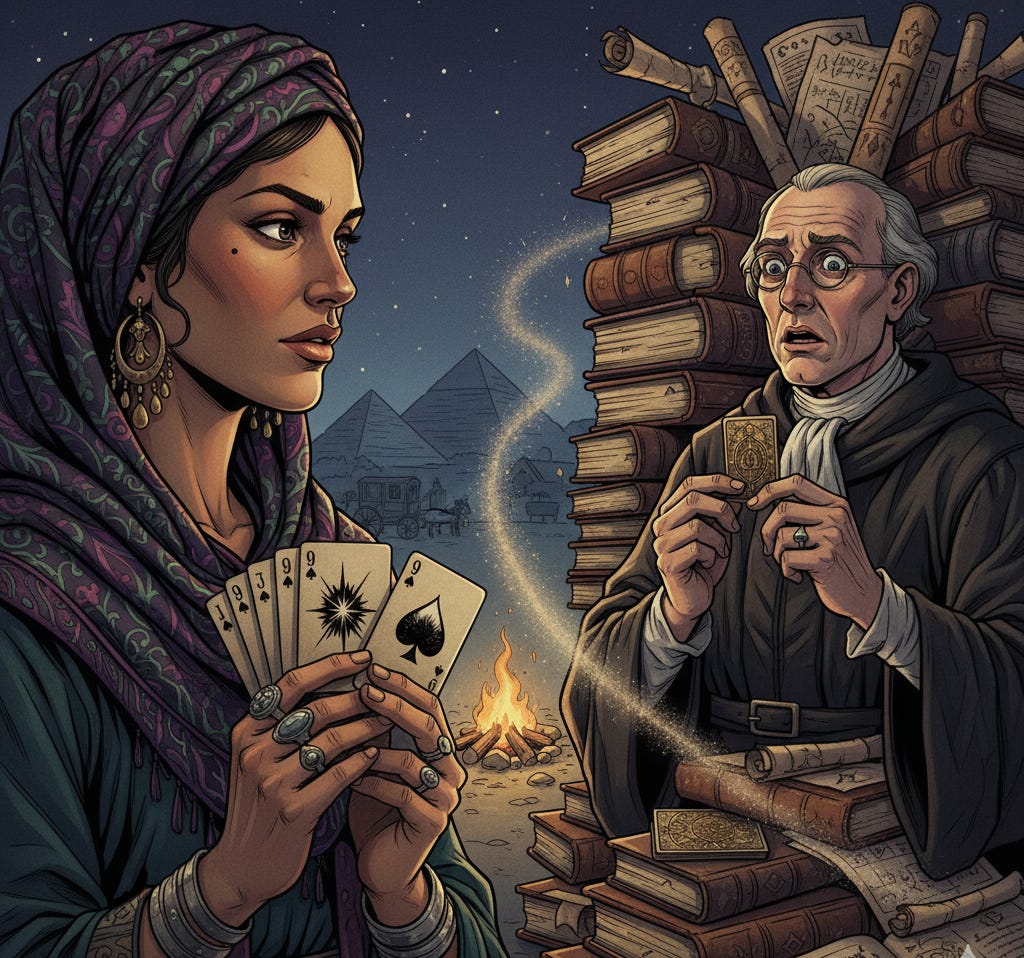
I love fortune-telling. It’s a wonderful mechanism for framing choices and, frankly, avoiding fucking disasters. Why wrestle with a difficult decision when the universe-channeled through a standard 52-card deck-can simply give you a heads-up? “Sorry, can’t go out tonight,” I might declare, dramatically flipping the Nine of Spades onto the table, “the cards told me you’d be an absolute arsehole to me tonight, and I’d resent your worthless existence for life.” The cards don’t just predict; they provide highly useful justification.
But for all the performative flair, the true heart of Cartomancy lies in the history of the Romany people, who didn’t just use a deck of cards-they elevated it from a parlour game into a profound spiritual practice.
The Arrival of the Game, The Birth of a Practice
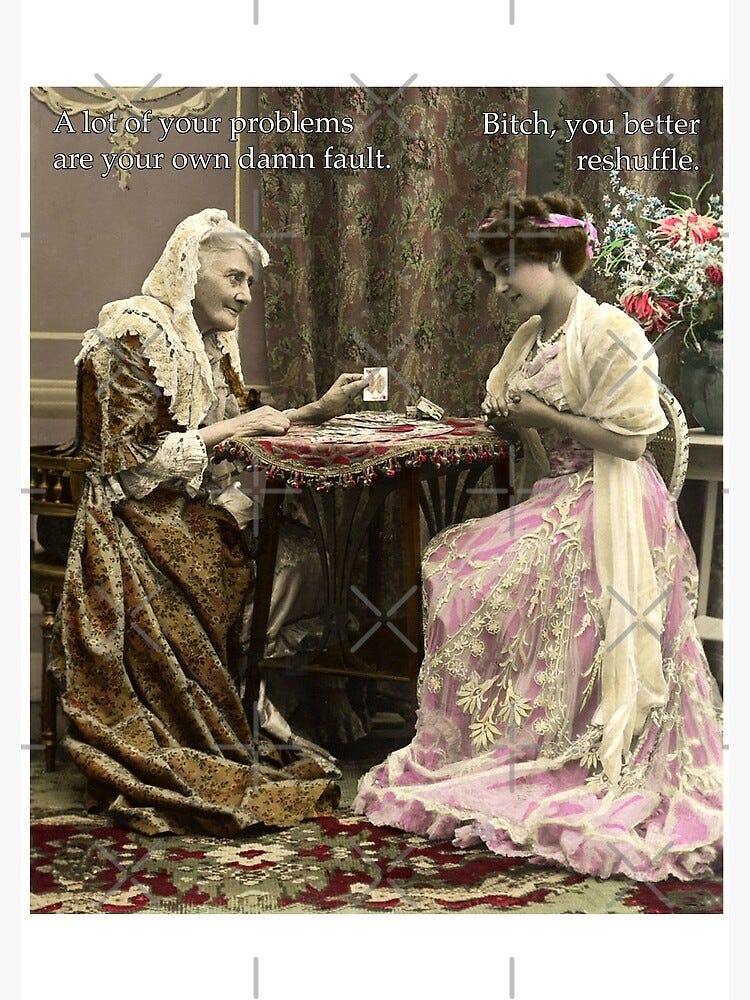
The historical background is relatively mundane to be honest: playing cards, imported from the East via Mamluk culture, arrived in Europe in the 14th century. For decades, they were used for what they were: paper and ink for gambling, strategy, and recreation. Their purpose was to amuse, to distract, and occasionally, to bankrupt. These were, emphatically, not sacred objects; they were the 15th-century equivalent of mass-produced party supplies.
The real transformation began with the Romany people, who migrated into Europe in the early 15th century. Their arrival was met not with a welcoming committee, but with suspicion, legislation, and outright persecution. Their itinerant lifestyle, a necessity born from chronic displacement and discrimination, precluded them from settling into trades like tailoring, blacksmithing, or farming. They were systematically locked out. They needed economic survival, and quickly. They relied on services that were both mobile and in high demand-and what is more universally desired than a peek into the future? Fortune-telling, already rooted in ancient Romany spiritual concepts like dukkering and bocht (words associated with the ghostly and fate), became a necessary, and highly valuable, form of commerce.
They didn’t wait for a special, illustrated deck full of allegories. They took the cheapest, most ubiquitous tool available-the standard French-suited playing deck-and imbued it with centuries of their own spiritual knowledge. The Clubs became about future actions, travel, and fire, the Diamonds about finance, ambition, and earth, the Hearts about emotion, home, and water, and the Spades about conflict, challenges, illness, air and gasp… death! They created a portable, encrypted spiritual tradition that could be packed up and moved at a moment’s notice, carried right under the nose of suspicious local authorities.
This was not a simple transaction; this was spiritual ingenuity born of survival. The Romany didn’t invent the cards, but they invented the system of deep, interpretive meaning that allowed 52, (54 if you count the Jokers) pieces of pasteboard to hold the weight of a human life, providing counsel, validation, and a moment of powerful, personalised attention that clients desperately craved. It was a service born from resilience, making magic out of the readily available.
Imagine the shift: The King of Hearts, once just a royal portrait in a game of poker, suddenly becomes a warm, kind-hearted man in your life-a person of genuine influence and good will. I get all excited if I pull him in a reading! The transformation of a club game into a lifeline of faith is the real miracle here. It proves that belief, not artistic merit, is the engine of prophecy.
The Magic: Belief Versus Books and the European Envy
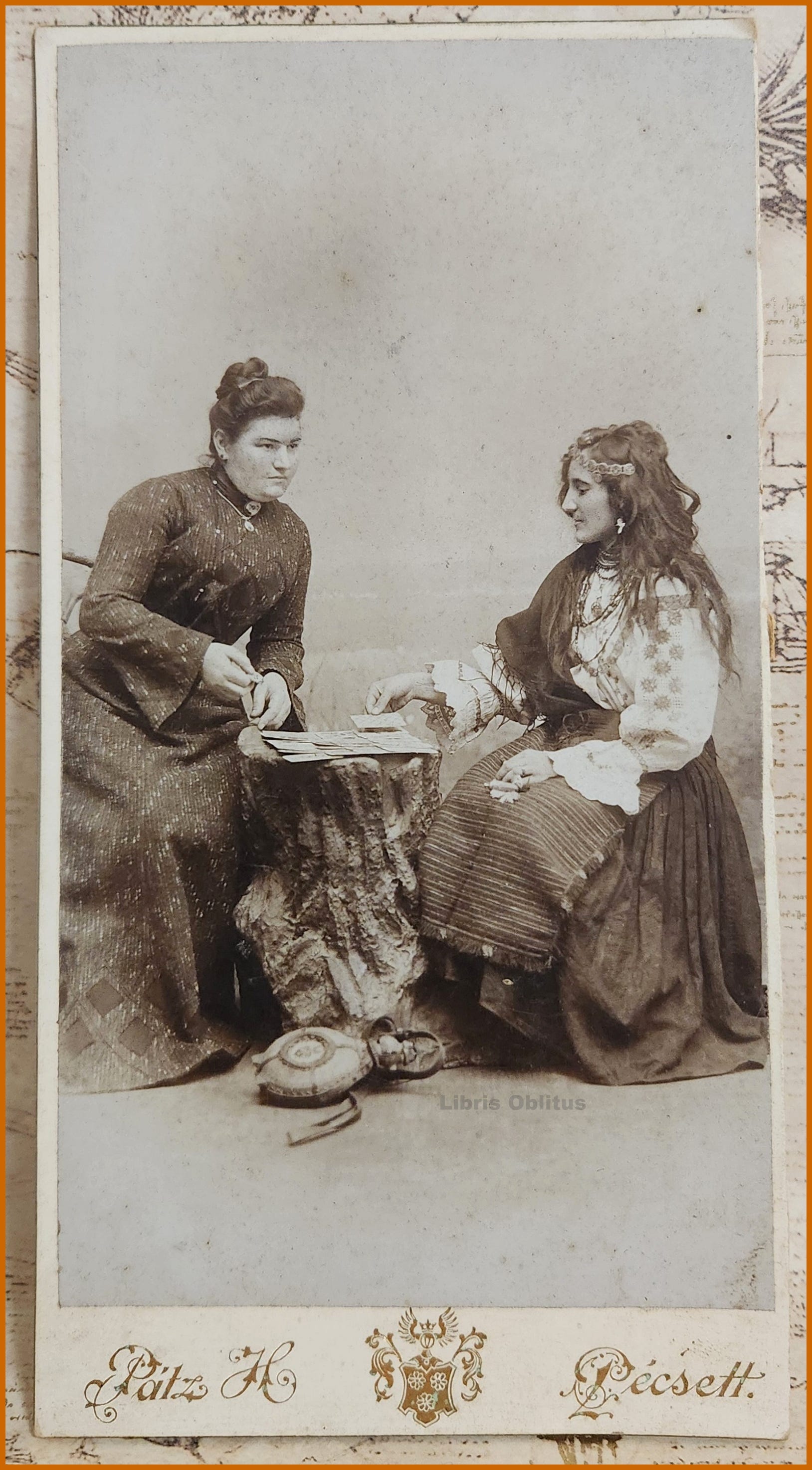
The profound belief in the power of the cards was passed down through generations, traditionally it is passed from mother to daughter. My mother taught me, just as her mother, my chavani - taught her. This tradition, rooted in personal connection and word-of-mouth teaching, is where the genuine magic lies. It bypassed the need for tedious, pseudo-intellectual rulebooks, relying instead on observation, intuition, and a deep understanding of human nature sharpened by years of nomadic life. The cards didn’t just have meanings; they had feelings conveyed by the reader’s deep spiritual connection, a sense of immediate truth that required no footnotes or expensive reference texts. Their interpretations were tailored, nuanced, and immediate-a stark contrast to the distant, theoretical systems that were to follow.
This organic, living tradition is precisely what the European occult elite found fucking intolerable. In the 18th and 19th centuries, the age of Enlightenment and Romanticism, these self-appointed ‘Mysteries Masters’- pretentious twatwaffles who could never simply accept that profound spiritual knowledge could come from a marginalised group using a common playing deck-stepped in. (Booooo!)
They took the Tarot deck (a distinct, more elaborate 78-card Italian game deck that the Romany had also incorporated, because a few extra pictures meant extra revenue) and declared it an “ancient secret” of Egypt, the lost language of the Sphinx, or the ultimate visual codex of the Kabbalah. They catalogued, codified, and over-intellectualised the practice, essentially taking the soulful wisdom of the road and translating it into dry academic prose. They seized the Romany’s economic ingenuity and recast it as their own esoteric discovery. They seized upon the existing Italian Tarot deck-which had been a game called Tarocchi for centuries-and began assigning lofty spiritual meaning to every single card, creating the complex, rigid systems we are familiar with today. This move effectively sanitised and appropriated the essence of the tradition.
The Romany had made cartomancy accessible and practical; the academics made it terribly, terribly obscure and then charged a fortune for the interpretation. They were selling the key to a door that the Romany had already left wide open. By creating the myth of a secret, elite lineage (often completely fabricated, tying it to Egyptian pharaohs or medieval secret societies), they elevated the practice beyond the ‘lowly’ street-side reading and ensured the system’s profit and prestige flowed back to the educated European classes.
The Lasting Legacy
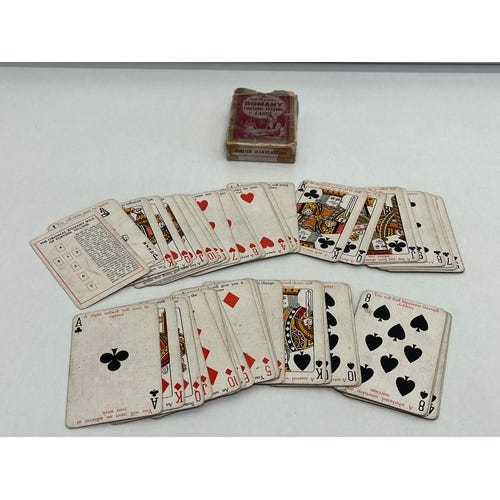
Today, when we shuffle a deck-be it a multi-coloured, highly artistic Tarot deck or a simple pack of Bicycle playing cards-we are engaging in a practice popularised by the sheer resilience and spiritual depth of the Romany people. They looked at a gambling tool and saw a mirror to the soul, an accessible path to prophecy that required nothing more than faith and a sharp eye.
They were the original, and best, interpreters. They proved that profound truths don’t need expensive, gold-leafed decks and obscure foreign languages. They just need someone with the spiritual knowledge, some emotional intelligence and the genuine belief to make those 52 cards talk. Their contribution to the world of divination is massive, yet often goes uncredited, buried beneath layers of European occult theory. It is a powerful reminder that necessity, ingenuity, and a deep current of belief are far more potent than any university education or published treatise.
The cards, in their Romany context, offer not just a prophecy, but a powerful lesson in making magic out of what little you have. Whether you believe in cartomancy or you don’t, those cards put food in hungry mouths and kept the power of human intuition alive and yes….while the cynic in me often prevails, every emotional crisis has me reaching for my fucking deck!
Absolutely fascinating.
This is so interesting. I love that it’s not a fossilized piece of folklore, but something that you still go to regularly, that you can still practice.
I had a Tarot reading once - I’m a rationalist with an open mind - and it was very insightful. I’m curious about this more rooted, ancestral version.